


Hi, I’m Max and I write fantasy, science fiction, and all sorts of genre stories as well as essays on the craft. If you enjoy what I write below, I’d appreciate you sharing the piece or subscribing to my newsletter more than you know! Or support me at my ko-fi here!
Each of my stories is stand-alone. However, many are in a shared universe. If you want to check out a specific world…
You can click here to dive into the fantasy world of Breiar
or click here for some science fiction
or check out my whole catalogue to see what fits the mood of the day here
A series, no matter the length, is a challenging thing to write. Each story must satisfy on its own while also building to something greater. The best series are so much more than the sum of their parts. The worst lose readers before any of "the good stuff" goes down.
Vonnegut and other authors talk of a story's "shape" with them rising, falling, circling back over each other, or merely being a flat line as a way to express either the status of the characters or the emotional beats or simply the plot of a book or story. If you haven't gone down that rabbit hole, I think it’s an interesting idea.
I want to talk about the shape of series.
I think a lot of long form fiction, with multiple installments, tend to play out in the shape of a diamond. The reader is thrown in at a single point: Rand, Frodo, Holden and Miller, and for the first installment, or at least the first good while, we follow only that character and their point of view. Then as time goes on, we meet more characters, we leave our main character's POV and see the world from another angle. We see what Egwene, Aragorn, or Bobby are thinking and doing while Rand and Frodo and Holden are off main-charactering their way through the tale. Time goes on and the cast grows ever wider. The story itself covers so much ground and so much of the world, readers get the fun question of: "how the hell are they going to tie this all together?" In the case of Wheel of Time, we end up with 147 characters we get a POV from. That is a wide diamond.
But then the fun really happens. The diamond starts to constrict. The number of POVs we read through may stay the same, but the story beats are connecting again, constricting and working their way together. In the Lord of the Rings, when the three hunters help defend Minis Tirith and come to the decision that the only way to help Frodo is a march on the black gate itself: the readers, the characters, and the plot are all in alignment again, towards a single point: Destroy the ring. There may still be unanswered questions of the wider world, but the text is focusing towards a goal, hopefully the goal that we began with so many words and books ago. Wheel of Time focuses its many characters into a singular point that's been discussed since Eye of the World, a behemoth of a chapter simply called: The Last Battle. The Expanse brings everything down to the survival of humanity in a battle on multiple fronts against Laconia, but even though it’s a wide battle, our focus is on the remaining crew we've watched live for the past nine books. We're with them at the tip of the diamond, rest of the 'verse be damned.
The Expanse is what made me think of this idea of a diamond. It begins with two POV characters for the entirety of its first novel, then quickly grows through the series and through the novellas to encompass many other points of view. Though the ending isn't perfect, it brings together all the disparate themes and plots into a focused ending.
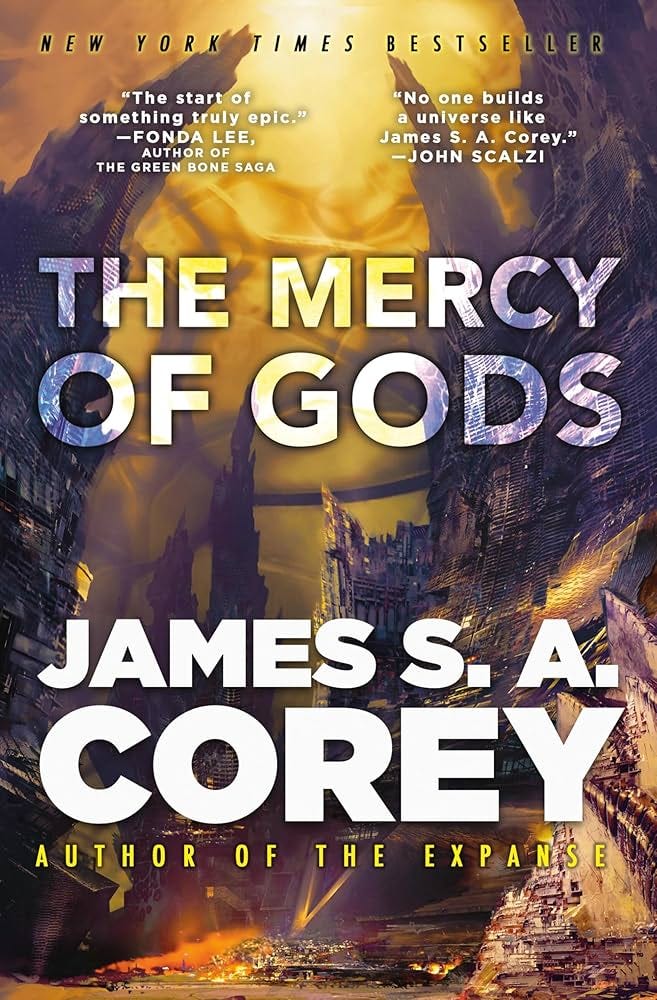
That's what stood out most to me as I read Mercy of Gods, the first book in a new series by James S.A. Corey, authors of The Expanse. (James S.A. Corey is the pen name of Ty Franck and Daniel Abraham)
There's no diamond point here.
Dafyd may turn into the Rand or Frodo or Holden and be the true protagonist/focus of the series. I think it is likely he does. But Mercy of Gods doesn't start as his story. It doesn't end as it either.
The book is a fun sci-fi romp. It throws you in the deep end of the pool in a new world: humanity on another planet where we definitely showed up as colonizers at some point in the past, but it is so far past that we no longer remember the details of our home. There is other life on this planet, from an entirely different tree of life, one that cannot reconcile well with our evolution. And there are a dozen or so people we bounce around following, scientists mostly, who are studying interesting problems of this odd circumstance humanity found itself in.
We follow so many different people, never quite knowing who to focus on. There is no diamond point to set the reader straight into the story. We fumble and try to keep up, much like the younger scientists working with those more experienced.
Then the aliens invade.
I didn't pay attention to the series title: "The Captive's War" before I started reading. Quickly it becomes an obvious title. Humans lose their war in hours. The scientists we followed at the start are prisoners, taken off planet and forced into a vague task, or test, to prove their worth to their captors.
How does everyone handle this situation?
Here the wide beginning with so many points of view and perspectives pays off. Everyone wants something different, fights for something different, or doesn't fight at all. We're all different kinds of prisoner. The story isn’t how one person handles captivity, its about how people do. How does humanity like being prisoner? What is more important: survival or freedom?
As the book ends, it proclaims that promise of all first books in a series: the world will grow. The story will grow wider in the next novel, and hopefully, come back to a satisfying conclusion in the third (it’s stated to be a trilogy). I'm interested to see what happens to a series when you start with so many threads to pull. What becomes the focus to end it on?
Thanks for giving that a read! If you like my art and want to drop a buck in my hat, I’d appreciate it more than you know. If you like it, and want to just keep reading for free, please do! Check out my latest (and maybe best) short story here!
Anyway, here’s the Tip Jar:
And if you’d just like to hang out here: check out my other stories, leave a comment, and share with whoever you want to!
And here are some pieces I read this week that are worth checking out:
Eric Falden wrote a great breakdown of his read of The Eye of the World by Robert Jordan (my recent post on it is here). He and I have different opinions on some of the specifics of the book and later series, but I cannot argue with any of the points he makes. He poignantly discusses my favorite book series in a way that’s honest. It really may be “the worst book that I love.”

Austin Kleon’s newsletter is a joy to read every Tuesday and Friday. You should all check it out. A few weeks back his letter on the home library brought a smile to my face and made me want to build another bookshelf to expand my collection:
